
Centering youth mental health - reflections from Hauora Hinengaro 2026
On 11 November 2026 in Tāmaki Makaurau Auckland, speakers and delegates from across Aotearoa and Australia gathered to focus on young people and the systems that support them. Four themes stood out.
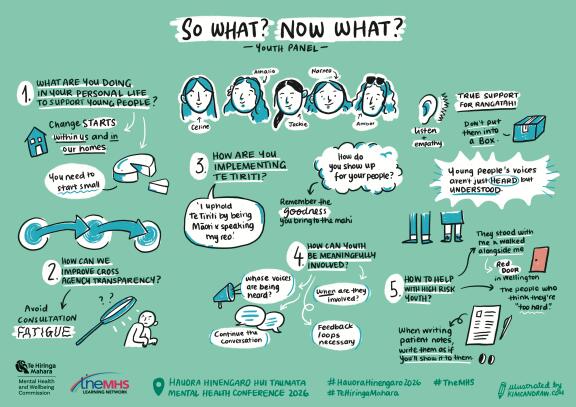
The day was energetic, thoughtful, and full of new connections. To capture the conversations and ideas shared during the day, illustrator Kim Anderson was on hand. She has created 7 visual stories that cover themes which emerged throughout the day.
Read and download: Hauoura Hinengaro Hui Taumata Mental Health conference 2026 illustrations (PDF 6.1MB)
Illustrations credit: Kim Anderson, Instagram: @kimcandraw, Website: kimcandraw.com
Young people lead, and the rest of us support
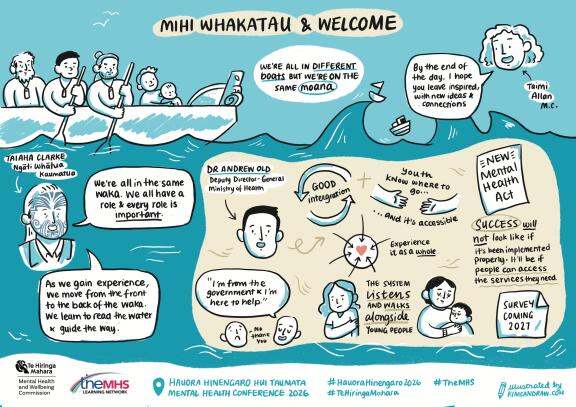
The day opened with a whakatau, welcoming guests from te iwi ahikā Ngāti Whātua Ōrākei. A message from the kaumātua set the tone: in a waka, young people paddle at the front and lead, while those with experience guide from behind. Knowing your place is key and young people need room to be young, and to find themselves among their whānau, people and communities.
That theme ran through the day. In our So what? Now what? session, young leaders laid down a wero, asking practitioners to:
- Consider what upholding Te Tiriti o Waitangi would look like in their practice.
- Look after the young people labelled “too hard” or “too high risk”.
- Share power with young people.
- Make sure there is a right door for support.
Better outcomes will depend on our willingness to listen, challenge our assumptions, and do things differently.
The energetic, participatory workshop generated a lot of ideas. These have been documented in a short synthesis report which will be shared in early December.
Distress is rising, and is cumulative
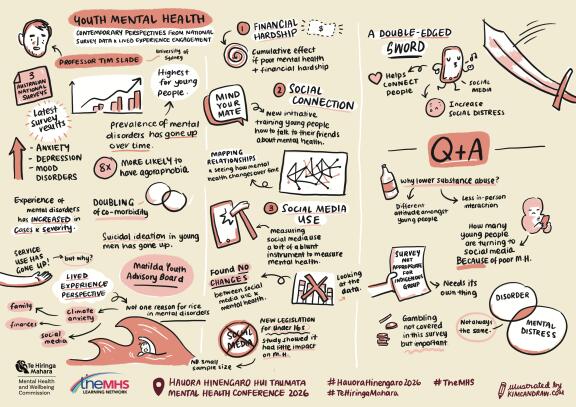
Opening keynote speaker Professor Tim Slade (The Matilda Centre for Research in Mental Health and Substance Use) presented research on drivers of youth mental wellbeing from large scale studies in Australia. Drivers include financial hardship, social connection, housing and work insecurity, the lingering effects of COVID, and the double-edged influence of digital media. We have heard the same from young people in Aotearoa and have published our own work on these drivers for young people’s mental health. As Tim put it: “Rising distress among young people is not monolithic, but cumulative.”
To improve youth mental health the scale of change is significant. Among young Australians, 1 in 4 met the criteria for mood and substance use disorders in 2007; by 2022 it was 1 in 3. While the Youth Aotearoa Survey will give us a view of mental health prevalence among young people in 2028 in NZ, what we do know from our population NZ health survey is that there continues to be an increasing trend for psychological distress for young people now from 23% to 25%. More young people are also seeking treatment. Whether the services and systems are there to support in time of need was explored throughout the day.
A connected system matters
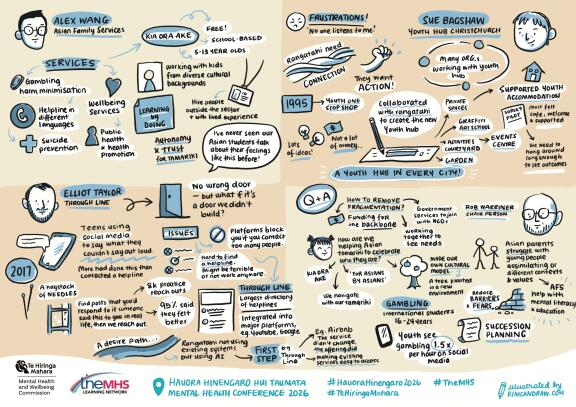
In the Building Better Crisis Services stream, speakers acknowledged real progress and investment over the past year. They were equally clear that the system remains fragmented, so the theme of integration was strong. Several practical points emerged:
- Relationships are key to making the system work better.
- Early intervention is critical. Young people dropping out of school is an early warning sign, and a sustainable workforce is essential.
- A connected system should not rely on peers going above and beyond.
- Crisis is a human experience, and a clinical response should not always be the starting point. Kim Holmes (Naemi National, Adelaide) described community-based alternatives to emergency departments, and invited us to ask “what’s happening for you?” rather than “what is wrong with you?”
A leaders panel session on crisis responses explored progress in response to the recommendations made at last years' conference. See below for an illustration of this work.
Solutions work best when they are grounded in lived experience, community and culture
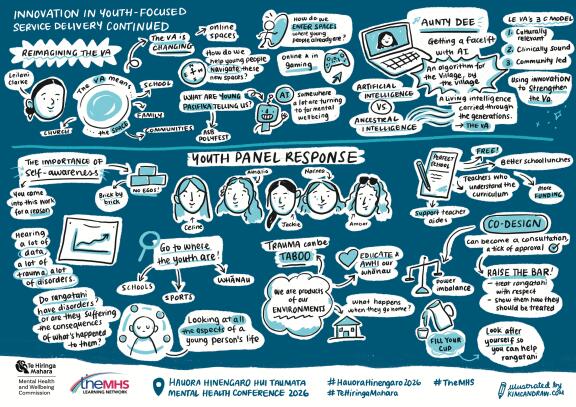
The Innovation in Youth-Focused Service Delivery stream showed what happens when approaches are built around the voices and experiences of young people:
- Belonging - NZ Rugby spoke about how rugby gives thousands of rangatahi a community and a place to talk about mental wellbeing, helping to challenge stigma.
- Schools as part of connected care - Dr Linda Bowden and our youth panel emphasised that schools are uniquely placed to address self-harm, with prevention that is co-designed, collaborative and connected.
- Kaupapa Māori approaches - Mahi Tahi Trust’s Te Awa Ora showed how culturally grounded care that nurtures identity, whakapapa, whānau connections and mana supports rangatahi and whānau with alcohol and other drug needs.
- Digital spaces - Leilani Clarke (Le Va) described how services can meet young people where they are, with Pasifika voices guiding tools such as Aunty Dee.
Closing keynote speaker Dave Letele, founder of The Brown Buttabean Motivation Program, brought these themes together with a personal story of turning struggle into strength and service to his community. His message was simple -Change is possible, if you can help you should, and just start.
Where to from here?
Young people across Aotearoa are experiencing rising levels of psychological distress, and there is growing concern aboutthe compounding impact of the online world, material insecurity and lack of connection to ensure a future that is certain. These trends not only deserve our attention, but they also ask something of us.
We want young people to feel they have a future here and a part to play in shaping it. That means more than creating opportunities to participate. It means creating the conditions for genuine belonging, real agency over decisions that affect their lives, and a future they can feel hopeful about.
Whilst there is universal agreement that improving youth mental health is a priority, greater urgency and collective action on the drivers of distress is needed. At times of need young people need access the services and supports they need.
Our focus on young people in the year ahead will build on the ideas, challenges and connections from the conference. We will keep asking how we can better support young people, how their voices can genuinely influence decisions, and how we can work together across communities and the sector to make a difference.
Ultimately, we want to see drivers of distress to be addressed, a system that listens to people and includes their voices, supports people early, before distress becomes crisis, is easy to access, responds effectively and compassionately when crisis does happen and centres people with lived experience and their whānau.
Thank you to everyone who contributed to the day by sharing expertise, challenging ideas and asking difficult questions. To those who could not join us, we hope you will be part of what comes next.
We look forward to continuing this mahi together and to seeing you at the 2027 conference.
Sign-up to our mailing list to receive regular updates, including event announcements: www.mhwc.govt.nz/sign-up