System performance monitoring
Updated: 16 June 2026.
A key role for Te Hiringa Mahara is monitoring how well the mental health and addiction system is delivering what people need. Our system performance monitoring assesses whether the system is delivering timely help, equitable access, age-appropriate support, and care that is safe, humane and effective.
The monitoring is based on a shared view of what a transformed mental health and addiction system looks like. Our first system performance monitoring report was published in June 2025 showing a system under immense pressure. The second report was published in June 2026 showing some areas of improvement but not for all people who need it.
In future years we will undertake annual high-level monitoring through an online dashboard and data summary, to be released in 2027.
Our aim is to give a clear picture of where the system is improving, where it is under strain, and where focused change is still urgently needed to deliver better outcomes for people and whānau. We draw attention to the drivers of distress, which will reduce demand on the mental health and addiction system and have wide-ranging benefits for people in Aotearoa New Zealand.
2026 system performance monitoring
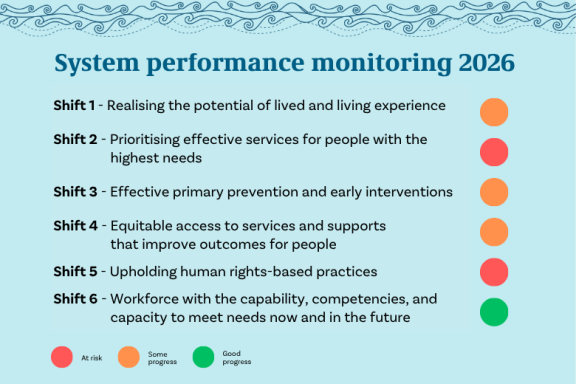
This 2026 system performance monitoring report shows that, while progress has been made overall, inequity for some groups requires urgent attention. Progress has been inconsistent across the six shifts, and the benefits are not reaching people with the highest mental health needs.
Since our 2025 reporting, good progress has been made on improving wait times for mental health and addiction services and government targets are being met for the total population. Overall, access has increased to primary mental health and addiction services and better access is available to specialist services that include peer support. Workforce vacancy rates are improving, and workforce diversity is increasing. We have also seen an increase in people entering training to work in the mental health and addiction sector.
These improvements are positive and should be celebrated as significant steps in the right direction. However, a truly transformed mental health and addiction system will support the needs of those who need it in a timely, accessible, culturally appropriate way and there are signs that despite these improvements, persistent inequities remain.
We are concerned about the widening gaps for some, which will ultimately cost everyone. Addressing this requires solutions that work for people with the highest needs, supported by clear and timely actions. We want to see better and equitable outcomes for Māori at all levels of the system, and more focus on supporting the mental health and wellbeing of young people.
Recommendations
Renewed effort is required by leaders of the mental health and addiction system across all six shifts to improve system performance and address inequities. Improving system performance will result in fairer outcomes for all and a better experience for tāngata whaiora as they move through the mental health and addiction system.
We are also calling for cross-agency commitment to address the factors that influence mental health and wellbeing at a population level. Addressing the drivers of distress will reduce demand on the mental health and addiction system and have wide-ranging benefits for people in Aotearoa New Zealand.
Based on our monitoring we are making two new recommendations for system improvement and renewing one:
- That Health New Zealand | Te Whatu Ora publishes a national ‘seclusion’ plan by June 2027 outlining the pathway to eliminate ‘seclusion’.
- That the Ministry of Health | Manatū Hauora includes actions for collection of outcomes and experience data from people engaging with mental health and addiction services in the first three-year implementation plan of the Mental Health and Wellbeing Strategy. Actions should include specific data collection for high-needs populations by June 2027.
- That Health New Zealand | Te Whatu Ora develops an action plan by June 2027 to meet the needs of Māori and whānau accessing specialist mental health and addiction services. (Renewed from June 2024).
2025 System performance monitoring report
Our initial monitoring findings showed that while there were some early positive movements in some areas, for example peer support workforce, overall, there is a system under significant pressure. Unmet need for mental health and addiction services has increased with Māori, Pacific peoples, young people, and disabled people experiencing much higher unmet need.
There are promising signs that the system is beginning to reorient towards the vision described in the He Ara Oranga report. There is evidence of movement towards realising lived and living experience potential and meeting community needs with increased access to services with peer support. Primary prevention and early intervention have been enhanced with the expansion of the Access and Choice programme, and the diversity of the workforce is changing to include more Māori, Pacific peoples, and Asian workers.
The need for faster progress to realise a transformed system that will achieve better mental health and wellbeing outcomes for people was identified. The early movements we observed were small and not yet extensive enough to realise the system transformation that will drive changes in population-level outcomes.