Improving wellbeing outcomes for people with experience of mental distress
Updated May 2026.
We have a unique role to monitor wellbeing outcomes for people in Aotearoa New Zealand and show cross-government contribution to improving mental health and wellbeing at a population level. The focus of this work over the last two years has been on assessing wellbeing for people with lived experience of mental distress and addiction. Skip to full reports
Alongside assessment of outcomes, we have undertaken further analysis to identify factors that are associated with improved mental wellbeing outcomes for people who interact with mental health and addiction services.
We know from our monitoring, research and from what our lived experience communities tell us, that people who experience mental distress and addiction face inequities in mental health and wellbeing outcomes.
Inequities in mental health and wellbeing outcomes are strongly linked to wider social, economic and cultural factors, for example, access to adequate income or housing.
We call on government to commit to consistent, nation-wide support to improve physical health, social connection, and material wellbeing for all people. There should be a particular focus on working with people with lived experience to support those outcomes for tāngata whaiora.
About the Wellbeing assessment for people who interact with mental health and addiction services
In the recent 2025 and 2026 wellbeing assessments we looked at both outcomes and factors that contribute to mental wellbeing. To do this we selected indicators from our He Ara Oranga Wellbeing Outcomes Framework and drew on three national social surveys. We compared the outcomes for people interacting with mental health and addiction services with the rest of the population. We do this to understand inequities in outcomes for people who interact with mental health and addiction services.
In 2025, we reported on the inequity for people who interact with mental health services, and those who interact with specialist mental health services in particular Māori, young people, LGBTQIA+ people, Pacific people and disabled people who face compounding and intersecting barriers to wellbeing. What we found is that:
- People who interact with mental health and addiction services experience poorer wellbeing outcomes
- Have lower household income, poorer physical health, and experience higher discrimination.
- Are less likely to have good individual and family wellbeing and access to protective factors such as social connection.
In the 2026 assessment, we report there has been no improvement in any of the 22 measures we looked at, for people who interact with specialist mental health and addiction services, between 2018 and 2023.
These findings show more needs to be done, within and beyond the mental health and addiction system, to address the inequities in mental health and wellbeing outcomes for people who experience mental distress and addiction. We want to see cross-government commitment to addressing the factors that support mental wellbeing.
For more background on the methodology behind our wellbeing assessment and analysis, see our detailed methodology report (PDF 875KB).
What matters for mental wellbeing – where to focus for cross government action
Our mental health and addiction service and system monitoring reports have shown that services and the system are under immense pressure.
We also report on the increasing levels of distress for young people and growing demand for a whole-of-government response. To support people to thrive, we need to prevent mental distress in the first place and address the factors that contribute to poor mental health and wellbeing. We set out to understand what factors are more strongly associated to mental wellbeing overall.
Our analysis shows that some factors are strongly associated with mental wellbeing:
- Good self-reported health had a very strong relationship with mental wellbeing.
- Social connection and whānau-related factors are also strongly associated with mental wellbeing.
- Material wellbeing indicators are strongly related to good mental wellbeing.
What we want to see change
We want to see mental wellbeing outcomes make up part of the decision-making in the systems that support health, social connection, and material wellbeing.
We also want to see the mental health and addiction system and services better support the health, social and material wellbeing of people who interact with their services.
This latest report will help us prioritise our future assessments, reporting, recommendations and advocacy – and will help government agencies and other bodies to prioritise their own efforts. We are planning further work bringing together agencies, NGOs and other stakeholders with tāngata whaiora to shape ongoing effort to support wellbeing and mental health outcomes – and to monitor the results.
-
Wellbeing assessment: people who interact with mental health and addiction services downloads
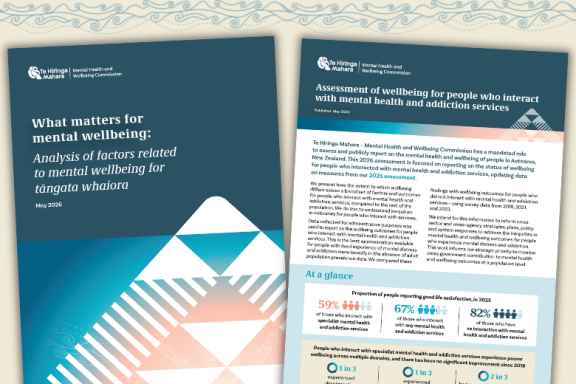
The second Wellbeing assessment explores the wellbeing status for people who interact with mental health and addiction services. Published May 2026.
- Infographics
-
What matters for mental wellbeing downloads
In this new report we have sought to identify the factors that are associated with improved mental wellbeing outcomes for tāngata whaiora. Published May 2026.
- Report
-
Wellbeing assessment: people who interact with mental health and addiction services (2025)
Our first assessment comparing status of wellbeing for people who interact with mental health and addiction services. Published June 2025.
- Infographics